Legal Disclaimer
This site provides general legal information. This information can help you understand the law and processes that apply at the border, your rights and responsibilities and when and where you can get help.
This website does not provide legal advice about your specific situation. This information does not tell you what will happen to you at the border or what decision you should make.
The law that applies to people arriving at the Canada-United States border is complex and every person’s individual situation is different. We encourage you to get legal advice. Learn about the legal services that our clinic provides to see if we can help you.
Common Questions
If you ask for refugee protection in Canada, the government first decides if your claim can be decided by the Immigration and Refugee Board (IRB).
Sometimes the government decides that your claim is “ineligible” to be sent to the IRB. This means:
- You will not have a refugee hearing at the IRB
- Your claim will not be decided by the IRB
- You may be placed in removal proceedings
- You may still have another way to ask for protection before you can be removed from Canada, called a Pre-Removal Risk Assessment (PRRA)
Your refugee claim may be ineligible for several reasons, including:
Your refugee claim is ineligible if your previous refugee claim in Canada was:
- found ineligible
- refused by the IRB
- abandoned
- withdrawn after it was sent to the IRB
This does not apply to claims that were withdrawn at the border before they were sent to the IRB.
Canada, the United States, the United Kingdom, Australia, and New Zealand are known as the “Five Eyes” countries. These countries share biometric information, including fingerprints. Your refugee claim in Canada is ineligible if the Canada Border Services Agency (CBSA) receives information showing that you previously made a refugee claim in one of the other Five Eyes countries.
It does not matter whether your claim was accepted, refused, withdrawn, abandoned, or is still pending. In most cases, making the claim is enough to make your refugee claim in Canada ineligible.
Canada considers a Credible Fear Interview in the United States to be the same as making an asylum claim. This means that even if you never filed Form I-589, your refugee claim in Canada is ineligible if you had a Credible Fear Interview.
Your refugee claim is ineligible if you already have refugee status in another country and Canada can return you to that country. Canada considers Withholding of Removal status in the United States to be the same as refugee status.
If your claim is ineligible for this reason, you cannot apply for a Pre-Removal Risk Assessment (PRRA). Instead, you may be able to apply for a different type of risk assessment called a subsection 115(1) risk assessment. This assessment looks at whether you would face a risk if you were returned to the country that gave you refugee status.
We recommend getting legal advice as soon as possible if this applies to you.
Your refugee claim is ineligible if Canada has decided that you are inadmissible because of security concerns, serious criminality, organized crime, or human rights violations.
If your claim is ineligible for this reason, you will only have access to a restricted Pre-Removal Risk Assessment (PRRA).
If your PRRA is successful, you will be protected from being removed to your country of origin because of the risk you face there. However, you will not become a Protected Person.
We recommend getting legal advice as soon as possible if this applies to you.
Your refugee claim is ineligible if you make your claim more than one year after first entering Canada. For this rule, it is your first entry into Canada that matters, even if you later leave and return.
This rule applies only if your first entry into Canada was on or after June 24, 2020. If you have been in Canada continuously since before that date, this rule does not apply to you.
This rule also applies only to refugee claims made on or after June 3, 2025. If you made your refugee claim before that date, this rule does not apply to you.
Your refugee claim is ineligible if you entered Canada between official border crossings and made a refugee claim from inside Canada more than 14 days after entering Canada.
This rule applies only to refugee claims made on or after June 3, 2025. If you made your refugee claim before that date, this rule does not apply to you.
This rule applies only to refugee claims made from inside Canada. It does not apply to people who make refugee claims at official border crossings and qualify for an exception to the Safe Third Country Agreement (STCA).
Important: If you have been in Canada for 14 days or less when you make your refugee claim, you must qualify for an exception to the STCA. If you do not qualify for an exception, you will be returned to the United States.
Unfortunately, no.
Once you have made an asylum claim in the U.S., your refugee claim in Canada will be ineligible. This is true even if the U.S. claim is later withdrawn, abandoned, refused, accepted, or remains pending.
No. An ineligible refugee claim and a return to the U.S. are two different issues.
If you qualify for an exception to the Safe Third Country Agreement (STCA), you will be allowed to enter Canada, even if your refugee claim is ineligible.
An ineligible claim means that your refugee claim cannot be sent to the Immigration and Refugee Board (IRB) for a refugee hearing. Instead, your case will continue through a different process.
You will receive a removal order. However, before you can be removed from Canada, you may have an opportunity to apply for a Pre-Removal Risk Assessment (PRRA).
If the Canada Border Services Agency (CBSA) decides that your refugee claim is ineligible and it cannot be sent to the Immigration and Refugee Board (IRB), the officer should give you:
- a letter stating that your claim is “not eligible to be referred to the Refugee Protection Division” of the IRB
- a document called an Acknowledgement of Conditions. The second page may include information about an appointment at a CBSA office in the area where you plan to live
- a document called the Minister’s Delegate Notes. These notes may indicate that your case has been sent to a CBSA office inside Canada to decide whether you are eligible for a Pre-Removal Risk Assessment (PRRA)
You will also receive a Refugee Protection Identity Document (RPID). Both eligible and ineligible claimants receive a RPID but it does not say whether or not your claim is eligible.
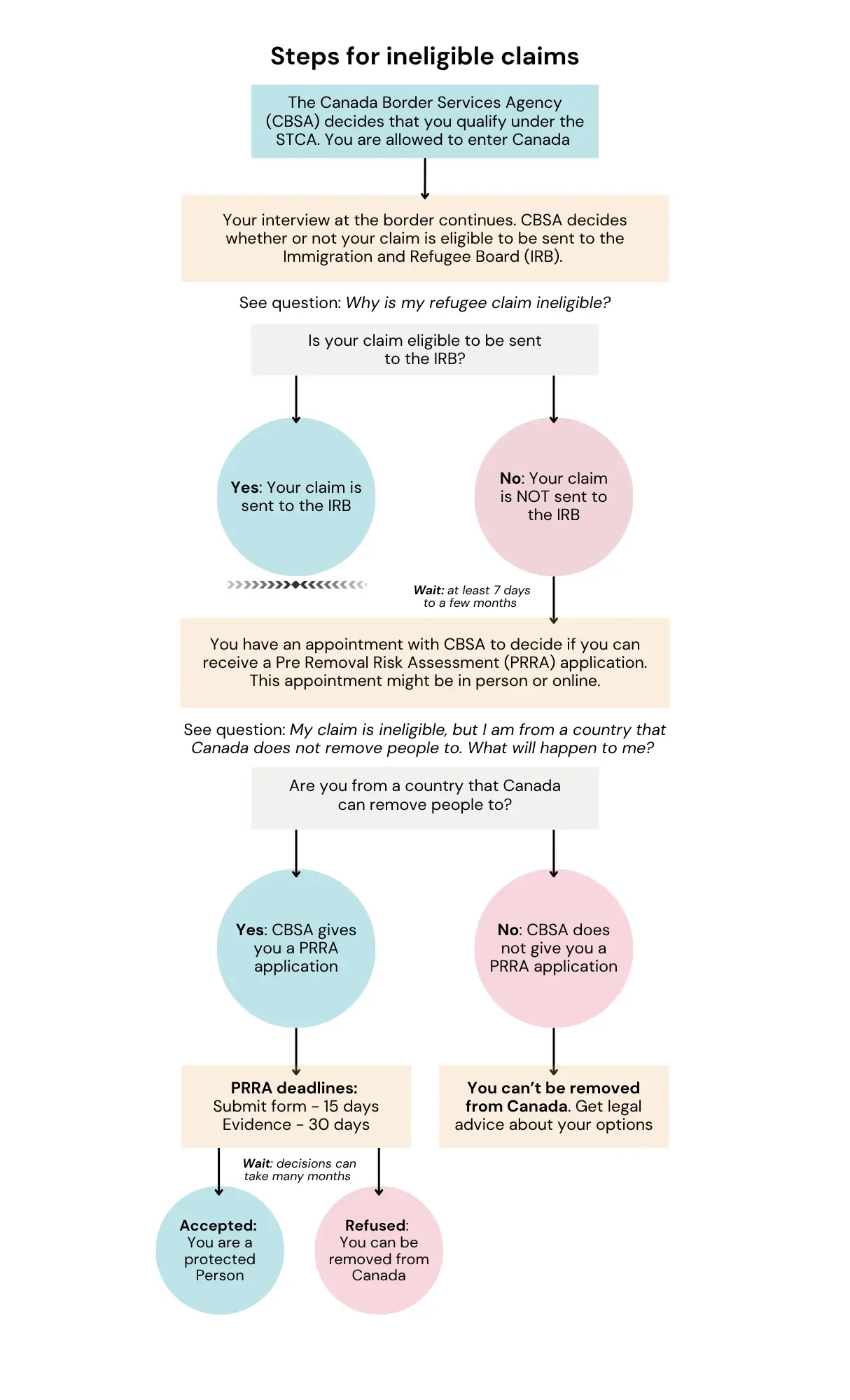
If you are from a country that is covered by an Administrative Deferral of Removal (ADR) or a Temporary Suspension of Removal (TSR), Canada usually cannot remove you.
There are some exceptions. Canada may still be able to remove you if you want to leave Canada or you are inadmissible for certain reasons, for example, you have a criminal conviction.
A Pre-Removal Risk Assessment (PRRA) is part of the removal process. It is normally only available to people who the Canada Border Services Agency (CBSA) can remove.
This means that if you are from a country on the ADR or TSR list, you are protected from removal. But you will not be able to apply for a PRRA until you can be removed from Canada.
You might be able to apply for permanent residence through humanitarian and compassionate (H&C) grounds or through other immigration programs. Our clinic does not advise on or assist with these applications. We recommend that you get legal advice about your options.
A PRRA is a written application where you can explain why it would be unsafe for you to return to your country.
The PRRA is different from a refugee hearing because:
- A PRRA is decided by an officer from Immigration, Refugees and Citizenship Canada (IRCC), while a refugee hearing is decided by a member of the Immigration and Refugee Board (IRB)
- Most PRRAs are based mainly on documents and written evidence. Most PRRA applicants do not have a hearing
- The deadlines to submit a PRRA and evidence are very short
- There is no appeal process for a PRRA
You cannot initiate your own Pre-Removal Risk Assessment (PRRA) application. A Canada Border Services Agency (CBSA) removals officer must give you the PRRA application package. CBSA will usually contact you and schedule an appointment to give you the application package.
At the appointment, you will receive:
- A PRRA application form
- Instructions and deadlines
- Information about how to submit your application
If you are 18 or older, you must complete your own PRRA application, even if other family members are applying.
After you get the Pre-Removal Risk Assessment (PRRA) application package, the deadlines to submit it are very short:
- You must submit the PRRA application within 15 calendar days of receiving it.
- You must submit any additional supporting evidence within 30 calendar days of receiving the package.
Important: You must submit the PRRA application on time (within 15 days), otherwise you can be removed from Canada before you get a decision.
Yes. You have the right to be represented by a lawyer for your Pre-Removal Risk Assessment (PRRA). We strongly recommend that you get legal help with your application. The deadlines are very short, and it can be difficult to prepare a strong application on your own.
If possible, contact a lawyer before your appointment where you will receive the PRRA application. This will give you more time to prepare and submit your application, including supporting evidence, before the deadline.
Some provinces provide legal aid to help pay for a lawyer to complete a PRRA application. Contact the legal aid program in your province to find out whether PRRA applications are covered and whether you qualify for assistance.
You might have a Pre-Removal Risk Assessment (PRRA) hearing. However, most PRRA decisions are made based on the written application and supporting documents.
You are more likely to have a hearing if:
- Your refugee claim was found ineligible because you previously made a refugee claim in another Five Eyes country (U.S., United Kingdom, Australia or New Zealand)
- The decision maker has questions about your credibility or evidence
Hearings may be online or in person.
Processing times for Pre-Removal Risk Assessment (PRRA) decisions vary greatly. Some people receive decisions within a few months. Others may wait much longer.
If your Pre-Removal Risk Assessment (PRRA) is successful:
- You will become a Protected Person
- You can apply for permanent residence
- You should receive written confirmation of your Protected Person status
- You can be an anchor family member in Canada under the Safe Third Country Agreement (STCA) if you have family members who are in the U.S.
Your outcome will be different if you have a “restricted PRRA” because you are inadmissible. You should get legal advice if that is your situation.
If your Pre-Removal Risk Assessment (PRRA) is refused:
- The Canada Border Services Agency may begin planning to remove you from Canada.
- You may have limited legal options.
- Deadlines to challenge the decision are short. An application for Judicial Review to the Federal Court of Canada must be filed within 15 days and your removal will not automatically be stopped during this process.
You should get legal advice as soon as possible.
Yes. However, you will not automatically receive a work permit, and you will have to pay processing fees.
You can apply for an open work permit after receiving your Refugee Protection Identity Document (RPID).
Yes, you can access health coverage through the Interim Federal Health Program (IFHP).
Your Refugee Protection Identity Document (RPID) or Acknowledgement of Claim (AOC) are your proof of coverage to take to medical service providers.
Learn more about IFHP and how to access health care.
This depends on where you live, as the rules are different in each province.
You can contact a local refugee serving organization in your local area to learn if you can access social assistance, as well as to help you if you are facing barriers in getting it.