Legal Disclaimer
This site provides general legal information. This information can help you understand the law and processes that apply at the border, your rights and responsibilities and when and where you can get help.
This website does not provide legal advice about your specific situation. This information does not tell you what will happen to you at the border or what decision you should make.
The law that applies to people arriving at the Canada-United States border is complex and every person’s individual situation is different. We encourage you to get legal advice. Learn about the legal services that our clinic provides to see if we can help you.
Common Questions
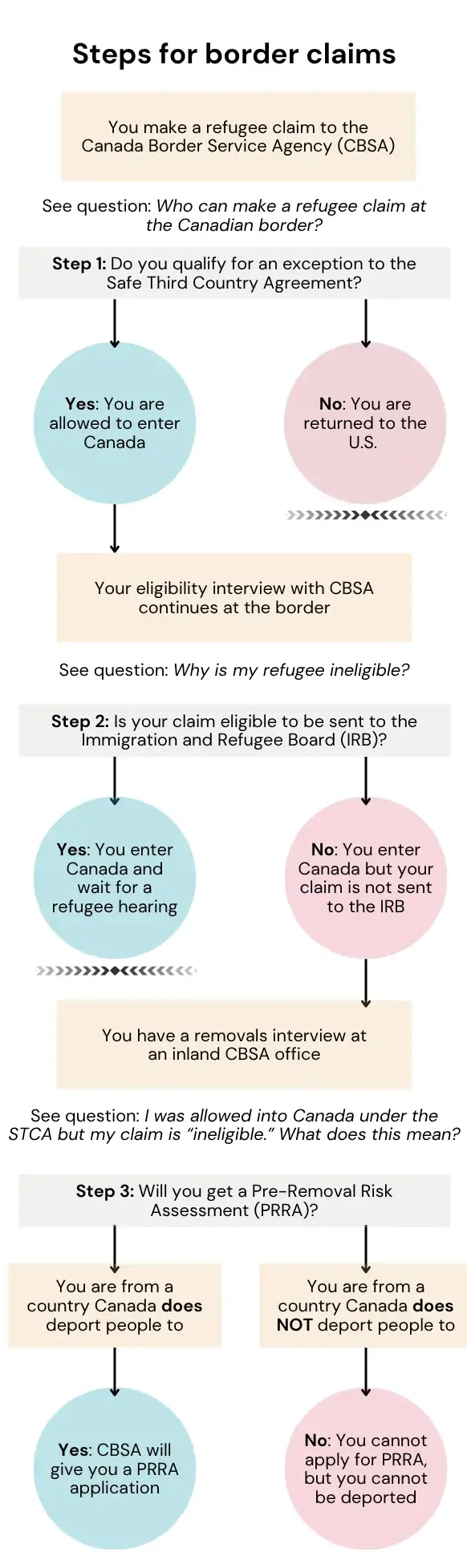
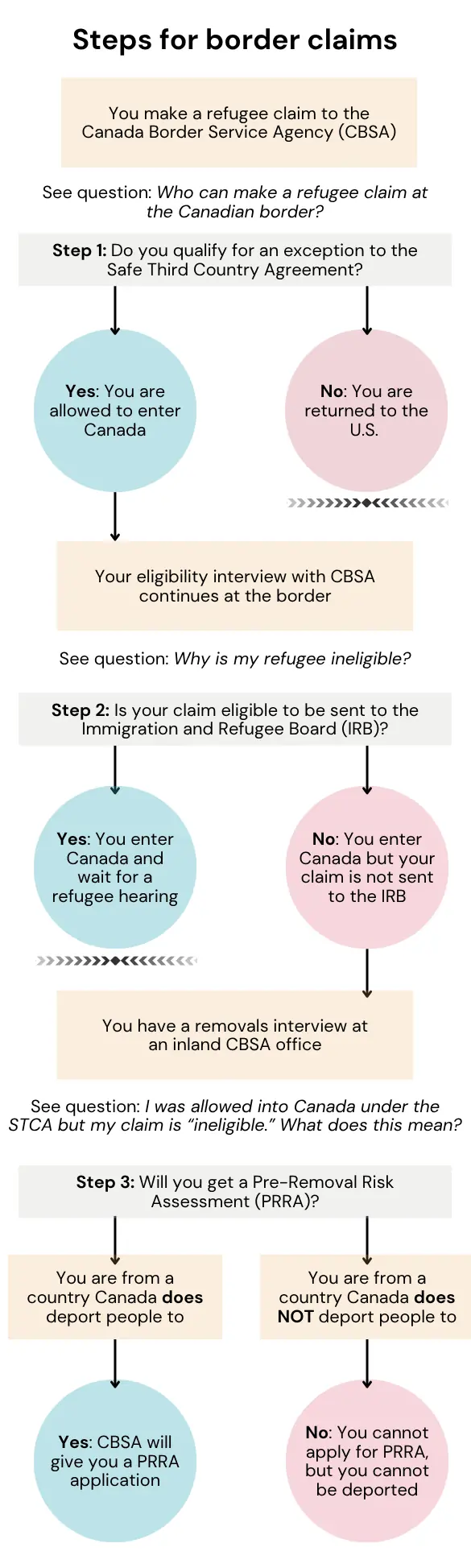
This flowchart shows you the steps that will take place when you make a refugee claim at the border. These steps are explained in more detail in the rest of the questions below. Make sure to read all the information carefully.
You can make a refugee claim at any official Canadian border crossing, officially called a land Port of Entry (POE). You do not need an appointment.
Before you travel, research the border crossing where you plan to make your claim. Not all border crossings are the same. Some allow people to cross on foot, while others require a vehicle. If you do not have a vehicle, a taxi company might not be willing to drive you across the border. Some border crossings offer advance appointments or have a dedicated refugee processing.
The Peace Bridge, which connects Buffalo, New York, and Fort Erie, Ontario, has a dedicated refugee processing unit with officers who specialize in processing refugee claims. The Peace Bridge also offers the option of booking an appointment in advance.
An appointment is not required, but it allows the Canada Border Services Agency (CBSA) to arrange an interpreter if needed and ensure that an officer is available to interview you. This may help make the examination process faster.
To make an appointment at the Peace Bridge:
- Call 905-994-6001
- Leave a message with:
- your name
- your phone number
- your email address
- the number of people included in your claim
- the language you need for interpretation
CBSA will contact you by phone or email with your appointment time and instructions. They may send you some forms that you can complete ahead of your appointment, but you do not have to. If you want to complete the forms, we recommend doing so with the assistance of a Canadian lawyer.
Watch the video from the Peace Bridge Authority to learn how to safely walk across the bridge.
You will be interviewed by officers from the Canada Border Services Agency (CBSA). You might talk to several different officers during your process.
The CBSA is the Canadian government agency responsible for managing the border.
If you want to make a refugee claim at the border, say that to the Canada Border Services Agency (CBSA) when you arrive.
CBSA will interview you, review your documents, and do other verifications to decide if:
- you qualify under an exception to the Safe Third Country Agreement (STCA) and are allowed to enter Canada
- your refugee claim is eligible to be sent to the Immigration and Refugee Board (IRB)
If you are making your claim with another family member, such as a spouse, CBSA might interview you separately.
CBSA may ask you basic questions about why you fear returning to your country of origin. Your responses may be written in your file and accessible to other immigration officials in the future.
CBSA will likely take your photo and fingerprints during this interview.
You need to prove to the Canada Border Services Agency (CBSA) that you qualify for an exception to the Safe Third Country Agreement (STCA). If you don’t have documents or information to do this, CBSA will not do their own research to help you. CBSA may not give you extra time to get documents while you are at the border.
CBSA will decide if you qualify for an exception to the STCA based on:
- the documents you give them
- their interviews with you
- their interviews with your family member in Canada, if applicable
- information in your or your family member’s immigration records
- any information they find about you online
- any other research they do
Based on all this information, CBSA will decide if:
- they believe you are telling the truth
- they believe your documents are genuine
- the documents and information you give them prove you qualify for an exception to the STCA
For example, suppose you are claiming the family member exception because your brother lives in Canada. CBSA may decide that you have not provided enough evidence to prove that you and your brother are related. This could happen even if you are actually related. Examples of reasons include:
- you did not bring your brother’s birth certificate to the border
- your parents’ names are spelled differently on your birth certificate and your brother’s birth certificate
- you don’t have your original birth certificate
- your birth certificate was issued recently, even though you were born many years ago
- your brother did not list you in a previous Canadian immigration application
- you and your brother gave different information during your interviews about other family members
When a family wants to make a refugee claim in Canada, each person in the family, including each child, must make their own refugee claim. This is different from some other immigration applications, where one person can apply on behalf of the whole family.
Each family member who makes a refugee claim is assessed separately to determine whether they qualify for an exception to the Safe Third Country Agreement (STCA). This means that one family member may qualify for an exception while another does not. Family members may receive different decisions at the Canadian border.
Example: What could happen to your family at the border
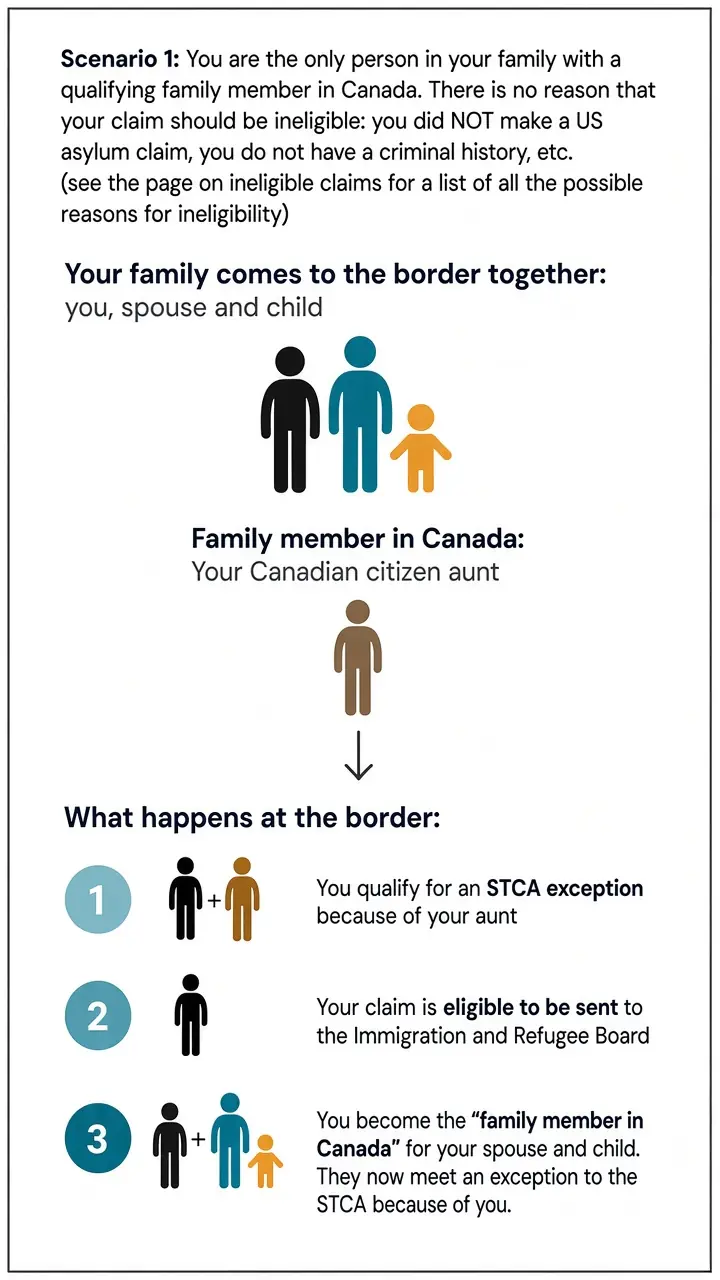
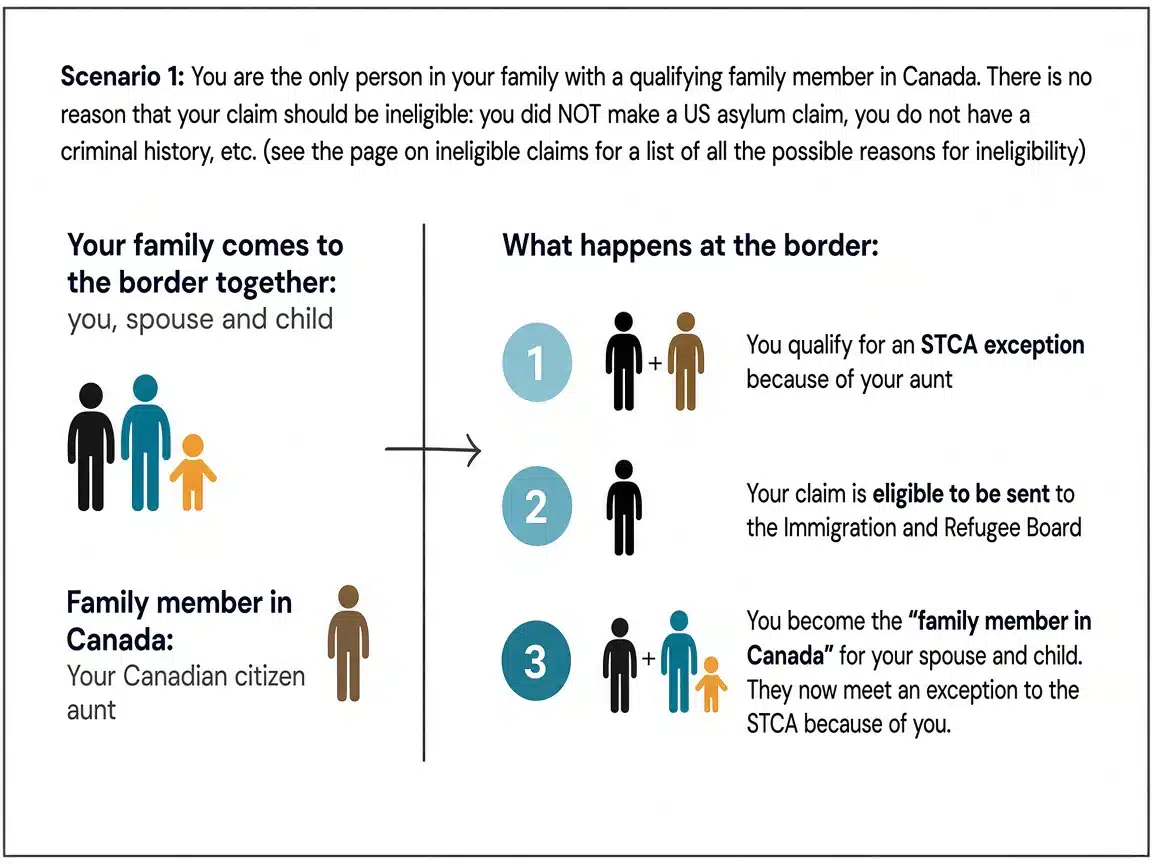
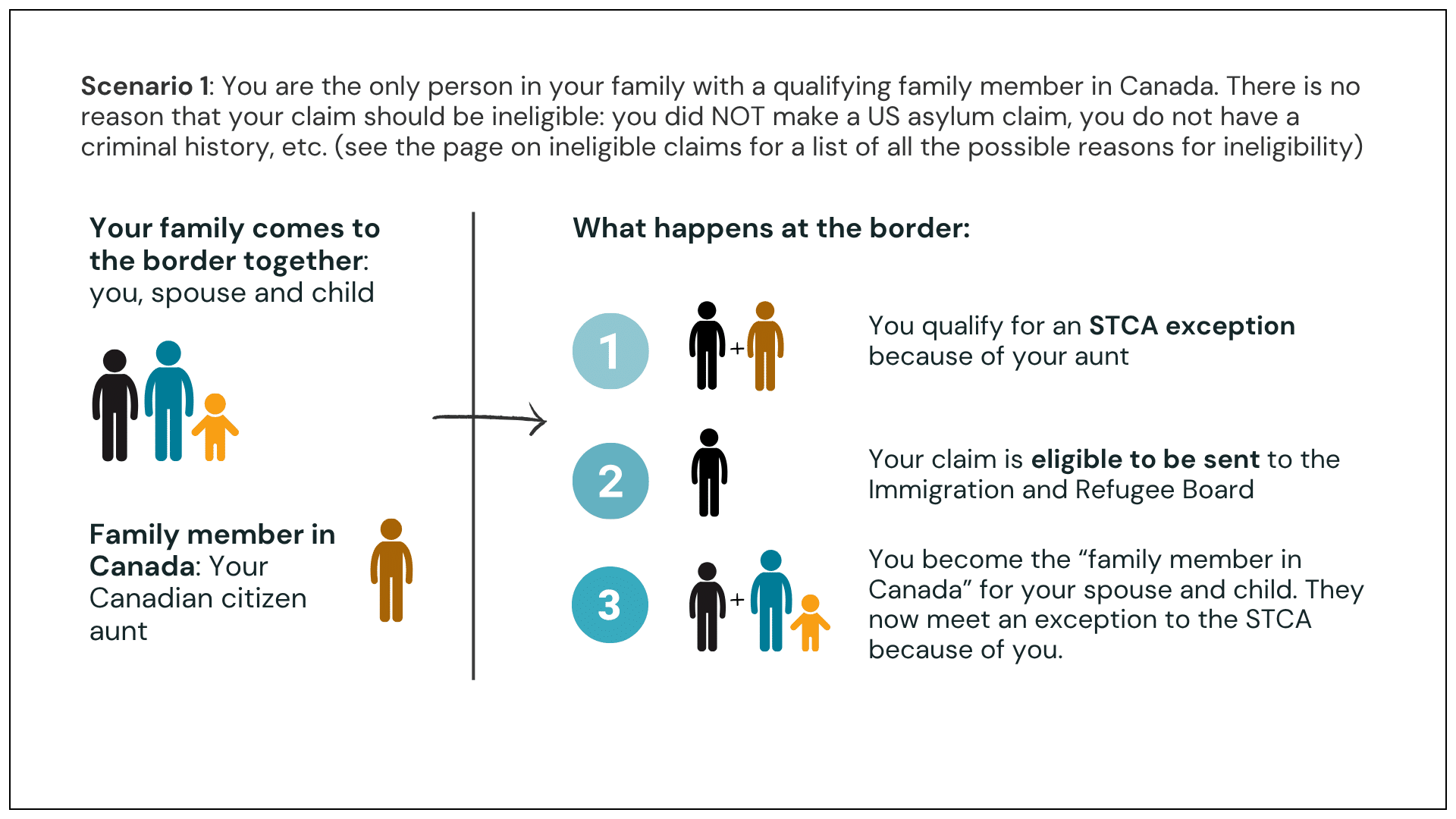
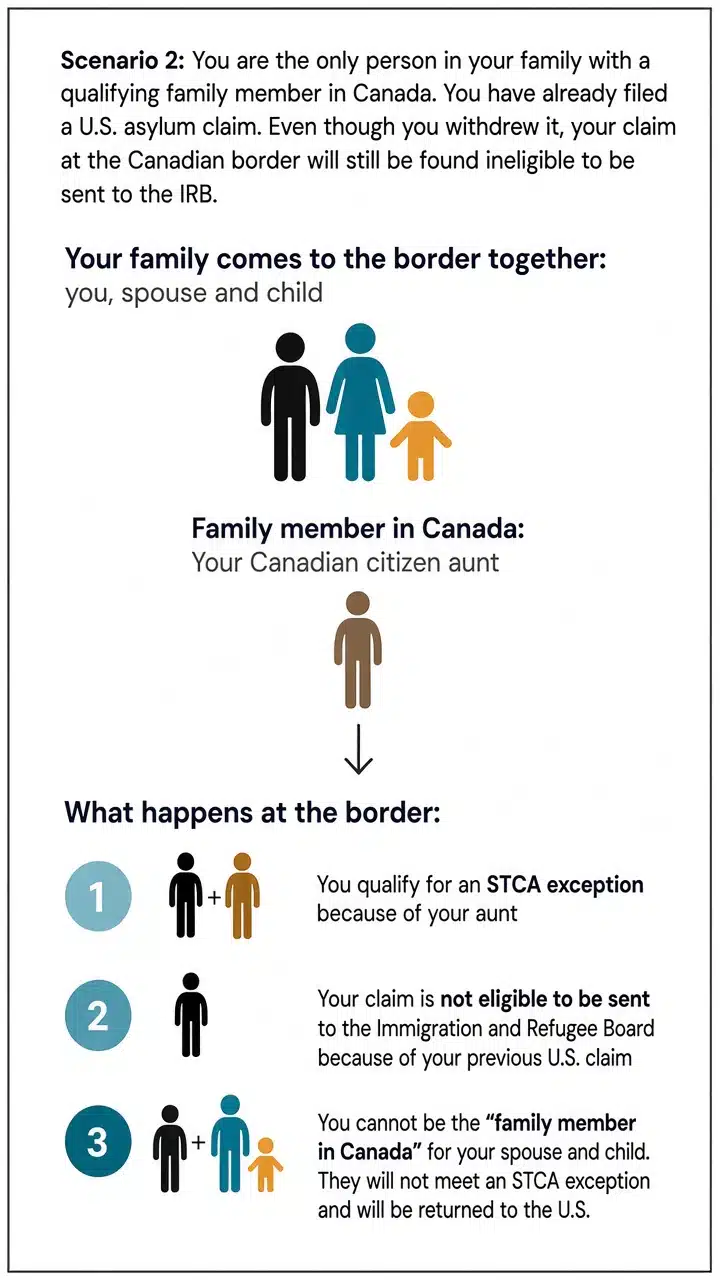
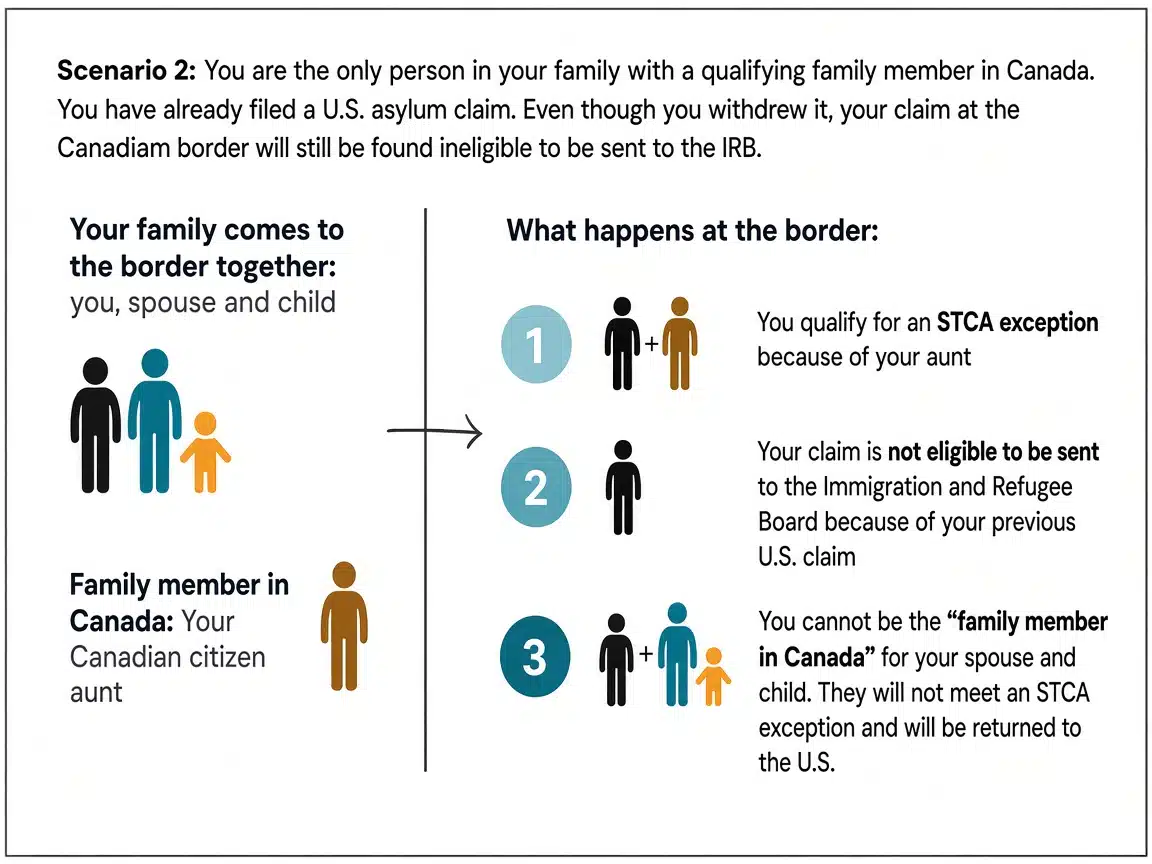
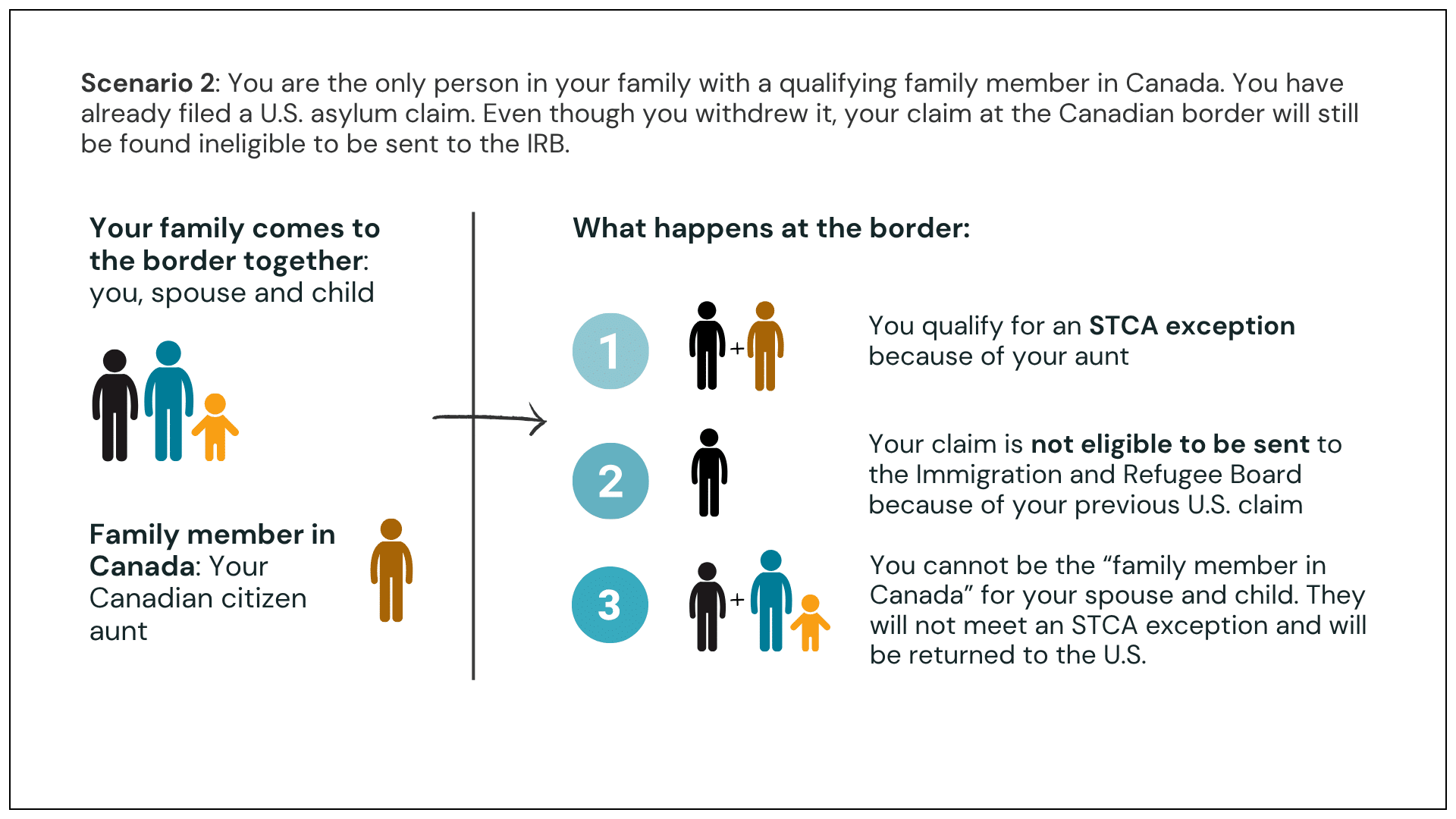
If you plan to make a refugee claim with your spouse and children using the family member exception, each person must qualify for an STCA exception.
Even if you qualify because you have a family member in Canada, your spouse and children may not automatically qualify.
For example, your aunt in Canada may qualify as your family member in Canada because an aunt is a qualifying family relationship. However:
- your aunt cannot be the family member in Canada for your spouse because they are not related.
- your aunt cannot be the family member in Canada for your children because she is their great-aunt, which is not a qualifying family relationship.
If you qualify for the family member exception and your refugee claim is eligible to be sent to the Immigration and Refugee Board (IRB), you can serve as the family member in Canada for your spouse and children. This may allow them to qualify under the family member exception as well.
Important: If you qualify for an STCA exception but your refugee claim is not eligible to be sent to the IRB, you cannot serve as the family member in Canada for other family members.
Before coming to the border, make sure you understand which members of your family qualify for an STCA exception. Family members who do not qualify may be returned to the U.S. and separated from the rest of the family. Some people who are returned to the U.S. may also be detained by immigration authorities.
We recommend that your family member in Canada come to the border. The Canada Border Services Agency (CBSA) may want to speak with them to confirm details about your relationship and family members. CBSA may ask both of you questions as part of this process.
Your family member in Canada may also have original documents that CBSA will want to review.
If your family member cannot come to the border, make sure they are available by phone in case CBSA wants to talk to them. The caller ID may appear as “GOC,” “Anonymous,” or “No Caller ID.”
1. You qualify for a Safe Third Country (STCA) exception and your claim is eligible to be sent to the Immigration and Refugee Board (IRB). See also: I qualify under the STCA and my refugee claim was found eligible. What happens next?
2. You qualify for an STCA exception, however, your claim is not eligible to be sent to the IRB. See also: I was allowed into Canada under the STCA but my claim is “ineligible.” What does this mean?
3. You do not qualify for an STCA exception. You will be given an exclusion order and returned to the U.S. Be aware of the possibility of detention in the U.S. and family separation. See also: What happens if I am turned back from the Canadian border?
If your claim is eligible to be sent to the Immigration and Refugee Board (IRB), the Canada Border Services Agency (CBSA) will:
1. Ask questions about your background. Be prepared to provide detailed information about:
- your addresses
- your employment history
- your education history
- your travel history
- your family members, including your spouse, children, parents, and siblings, even if they are not with you at the border
2. Take your photo for your Refugee Protection Identity Document (RPID). This is your official government-issued identity document as a refugee claimant. It is sometimes informally called the “brown paper.” See IRCC’s information page about the RPID.
3. Take your original identity documents, such as your passport, birth certificate, and other identity documents. CBSA should give you certified true copies of these documents.
4. Give you a claimant’s kit. The claimant’s kit includes:
- instructions for completing your claim online — pay attention to deadlines
- instructions for completing your medical exam — pay attention to deadlines
- a form to update your address
- a claimant’s guide
If you qualify for an exception to the Safe Third Country Agreement (STCA), you will be allowed to enter Canada. However, if your refugee claim is found ineligible to be sent to the Immigration and Refugee Board (IRB), you will not have a refugee hearing before the IRB. Instead, CBSA will process your case under the rules that apply to ineligible claimants. CBSA will:
1. Take your photo for your Refugee Protection Identity Document (RPID). This is your official government-issued identity document as a refugee claimant. It is sometimes informally called the “brown paper.” See IRCC’s information page about the RPID.
2. Take your original identity documents, such as your passport, birth certificate, and other identity documents. You should get certified true copies of these documents and a notice of seizure.
3. Give you an exclusion order. This is a removal order from Canada, but it does not mean that you are being removed now, as it is not in force. It is a normal part of the process for people who qualify under the STCA, but whose claims are ineligible. Canada cannot remove you without first assessing the risks you face in your country through a Pre-Removal Risk Assessment.
4. Give you information about a future CBSA appointment. CBSA will schedule a future appointment to discuss the next steps in your case. You might receive the appointment date while you are still at the border, or CBSA might contact you later with the date. CBSA gives this information sheet to people with ineligible claims.
We recommend that you read our information about ineligible refugee claims.
Important: If your refugee claim is ineligible, you cannot serve as a family member in Canada for other family members. If your family plans to make refugee claims together, it is important to understand this before coming to the border.
The time you will spend at the border can range from a few hours to a few days. This depends on:
- the border crossing where you make your claim
- the number of Canada Border Services Agency (CBSA) officers available
- the number of other people making claims
- the availability of an interpreter
- the number of people in your family
- the complexity of your case
Be prepared for the possibility of a long wait. Depending on the factors listed above, you may need to spend a night at the border.
Conditions vary from one border crossing to another. We recommend bringing food and water with you. If you need food or water, ask the Canada Border Services Agency for assistance.
You have the right to an interpreter at the border if you are not completely fluent in English or French. The Canada Border Services Agency (CBSA) will ask you what language you prefer. We recommend that you request an interpreter in the language you are most comfortable with.
Sometimes CBSA will have an in-person interpreter, but it is more common for the interpreter to be on the phone.
If you and the interpreter do not understand each other well, if they are not interpreting everything that is being said, or if you think they are not doing a good job, you should tell this to CBSA and request a new interpreter. It is very important that you and CBSA understand each other well.
The Canada Border Services Agency (CBSA) may search your belongings, including your electronic devices. They may keep your electronic devices for part or all the time you are at the border.
Tell CBSA if you need to access a document stored on your device or to contact a relative. We recommend that you bring a physical copy, preferably an original, of any document that you will need at the border.
The following resources explain your digital privacy rights at the border:
- Electronic devices Privacy Handbook – from the BC Civil Liberties Association (available in multiple languages)
- Video about your privacy rights at the border – from the BC Civil Liberties Association (English)
- Video about best privacy practices at the border – from the BC Civil Liberties Association (English)
If you are already in Canada and did not make your refugee claim at an official border crossing, you can submit a claim through the online refugee portal.
If you have been in Canada for 14 days or less when you submit your claim, you must qualify for an exception to the Safe Third Country Agreement (STCA). If you do not qualify for an exception, you will be returned to the U.S.
If you have been in Canada for more than 14 days when you submit your claim, you do not need to qualify for an exception to the STCA, but you may be required to prove that you have been in Canada for that amount of time. Your claim will not be sent to the Immigration and Refugee Board (IRB). Learn about ineligible claims.
Our clinic does not provide services or referrals after a person has entered Canada. However, many organizations across Canada help refugee claimants understand the refugee process, make referrals and access settlement services. Find an organization in your region.
It is important to get legal advice from an experienced lawyer. You may be eligible for legal aid to pay for a lawyer. Contact the legal aid agency in your province or territory to find out if you qualify, what services are available and how to apply.